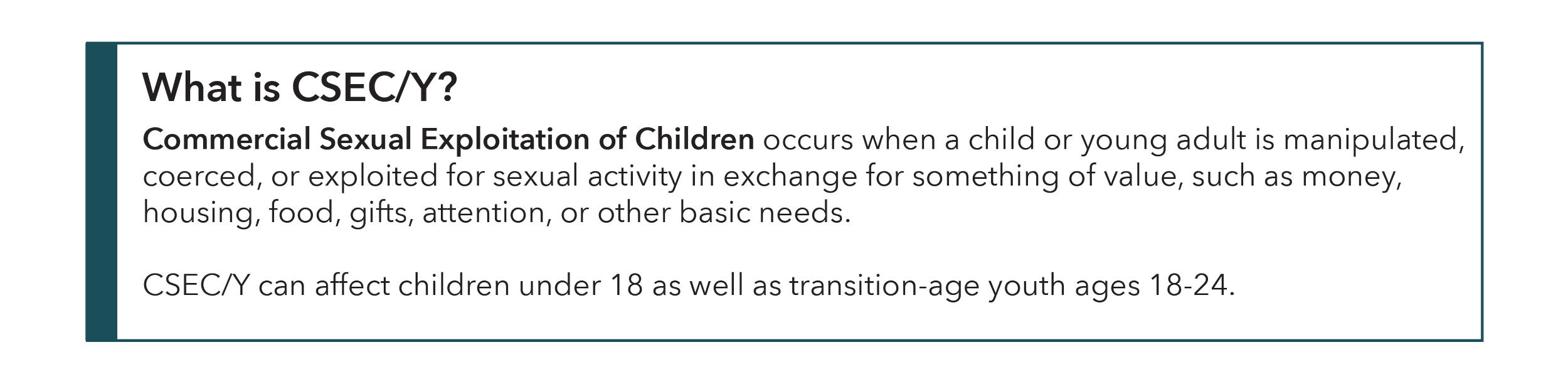
Commercial sexual exploitation of children and youth
Who Is Vulnerable?
Exploitation does not discriminate and can affect youth from any background. However, vulnerability increases when young people experience:
Prior abuse or exposure to violence
Housing instability or homelessness
Foster care or group home involvement
Family substance use or mental health challenges
Chronic school absences
Lack of connection, belonging, or trusted relationships
How Does Exploitation Happen?
Contrary to common myths, exploitation is rarely the result of a stranger kidnapping a child. More often, exploitation develops through a relationship built on trust.
Attention + Trust

Vulnerability
Emotional Dependence
Coercion
Exploitation
How You Can Help
Youth are less vulnerable to exploitation when they have:
Safe and stable environments
Positive adult relationships
A strong sense of belonging
Access to supportive services
KCI’s ROLE IN THE HTTF
Megan Riker-Rheinschild of the Santa Barbara's DA Office explains KCI's critical role in the Human Trafficking Task Force.
Transcend - Part I
This is one in a series of up to five short films which will include survivor stories and other dimensions of the fight against human trafficking. For more information on Filament Media, the series producer, visit their website or Vimeo page.
Transcend - Part II
This is the second in the Transcend documentary short series of up to five films which will include survivor stories and other dimensions of the fight against commercial sexual exploitation of children and youth. For more information on Filament Media, the series producer, visit their website or Vimeo page.
KCI currently serves as the facilitating organization for the Santa Barbara County Human Trafficking Task Force, which began in 2013 under the SB County District Attorney’s Office.
The official vision statement of the Santa Barbara Human Trafficking Task Force is to develop and enhance a multi-disciplinary HTTF team that implements victim-centered, collaborative, and sustainable approaches to:
Identify victims of all types of human trafficking
Investigate and prosecute sex trafficking and labor trafficking cases at the local, state, tribal, and federal levels
Address the individualized needs of victims/survivors through a comprehensive array of trauma-informed services
Since 2022, KCI has supported the SB County HTTF in the facilitation of a 29-member leadership team, which oversees the 3-Year Strategic Plan addressing human trafficking countywide with three major focus areas: 1) Sex Trafficking Tools and Protocols; 2) Prevention, Early Intervention, and Identification in K-12 Schools; and 3) Labor Trafficking. This 3-Year Strategic Plan comes to an end in late 2026, and the years spent tackling the Strategic Plan goals revealed service gaps and opportunities for more focused prevention and early intervention efforts against sexual exploitation in Santa Barbara City, specifically dedicated to supporting young people at risk of or experiencing Commercial Sexual Exploitation of Children and Youth (CSECY). In 2026, KCI is working with Santa Barbara city service providers, government agencies, businesses, faith communities, and more to create a focused, city-specific 3-Year Action Plan to meet the critical needs identified over the past several years.
To create and implement this 3-Year Action Plan, KCI has launched an undergraduate Fellowship Program with Westmont College students, who will aid in creating the plan in partnership with multi-sector partners KCI brings together. In engaging the next generation of leaders through the Fellowship Program, KCI hopes to equip them to solve social problems through the lens of collaborative leadership. Scroll to the bottom of the page to learn more!
KCI’s ANTI-TRAFFICKING EFFORTS
SAFE Santa Barbara County
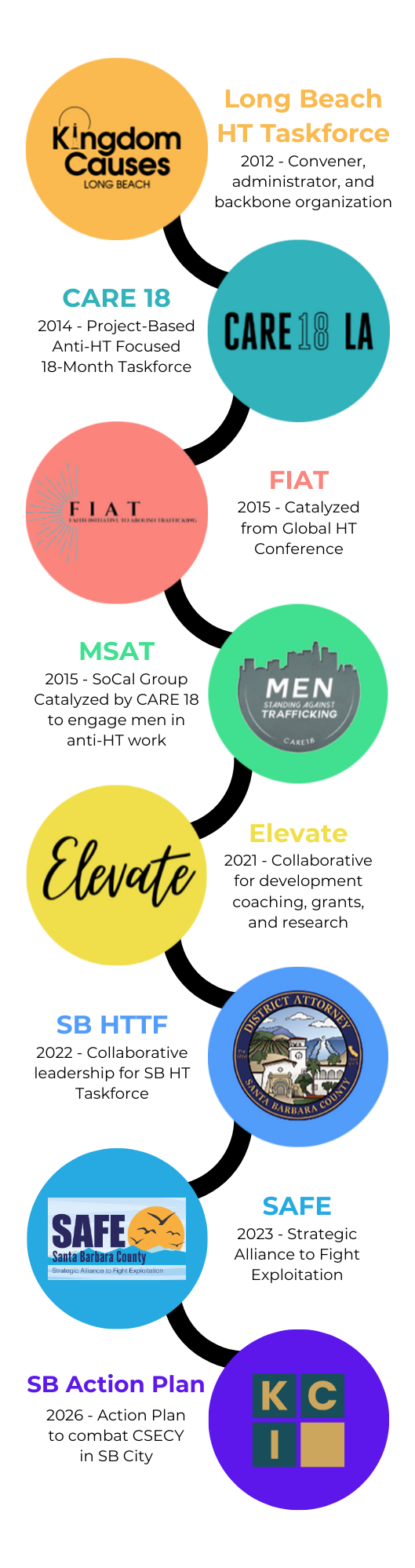
In 2023, KCI partnered with the County’s Human Trafficking Task Force and community partners to launch the Strategic Alliance to Fight Exploitation in Santa Barbara County (SAFE SBC).
SAFE SBC was created to support the 3-Year Strategic Plan with fundraising and awareness efforts throughout Santa Barbara County, through operating a fund that receives tax-deductible donations from SAFE partners and community members and allocates those funds to qualified, vetted organizations executing the Strategic Plan goals. The organizations that receive funds are a part of the larger movement to prevent human trafficking, assist at-risk populations, and protect survivors.
Check out the
2025 SAFE STRATEGIC PLAN
Impact Report!
Collaborative leadership
KCI uses the lens of “collaborative leadership” inspired by Stanford Social Innovation Review’s preconditions for collective impact. Read more here. The three major elements of collaborative leadership are an influential champion, who can bring multi-sector community members together to focus on a critical issue, ample funding resources that allow innovative and effective ideas to take root, and a community-wide recognition that something needs to change.
Collaborative leadership, simply put, means bringing everyone together to seek better outcomes through coordinated efforts and data collection, and teaching the next generation how to lead with courage and compassion.
-
An individual or group that brings together cross-sector decision-makers and keeps them engaged over time to fuel and maintain collaborative efforts.
-
Invested, multi-year funding to support the initiative’s efforts and rally others to the cause.
-
A moment of crisis that may cause a community to adopt a different approach, policy changes that require creativity, or a movement that reaches critical mass and propels the community forward.